Blog · Guides ·
VDN marks on Swedish porcelain – how to read the letter and the numbers
What does VDN F555, P555 or S533 under a Swedish plate mean? A complete guide to the VDN quality mark – the letters, the three digits and how to date the piece.
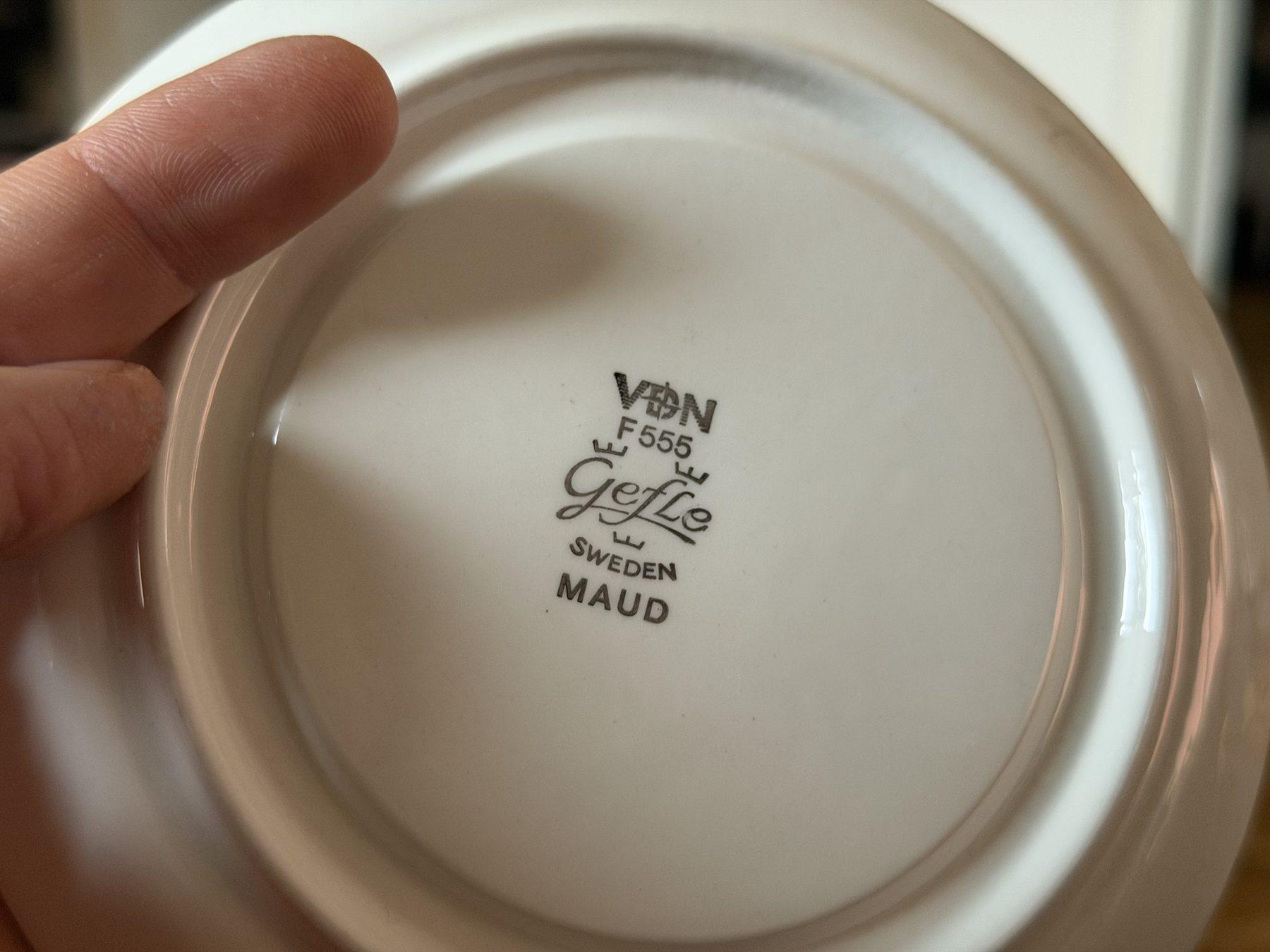
Turn over a Swedish plate or cup from the 1950s, 60s or early 70s and you’ll often find three letters and a code: VDN and, for example, F555. It looks like a model number, but it’s actually a small product declaration – a quality stamp that tells you what the ware is made of and what it can withstand.
Here I go through what VDN is, what each letter and digit means and how you can use the mark when hunting for finds.
What does VDN mean?
VDN stands for Varudeklarationsnämnden – the Swedish Product Declaration Board. It was formed in 1951 and run with support from both the state and industry. Its job was to give consumers comparable, objective information about products through standardised testing. That covered everything from electrical household appliances, saucepans and textiles to chemical products, food – and porcelain.
A product that passed the tests got a VDN mark. In 1973 the board’s tasks moved to the newly formed Swedish Consumer Agency (Konsumentverket), and the VDN mark came to an end.
For porcelain and ceramics, the mark became a code with one letter and three digits. The letter tells you the material, and the digits how the ware copes with glaze cracks, food and washing.
The letter – what material is it?
| Letter | Swedish term | Material |
|---|---|---|
| B | Benporslin | Bone china – thin, white and translucent. |
| F | Flintgods | Flintware – a hard, white body for everyday tableware. Common at Swedish factories. |
| K | Kalkgods | Calcareous earthenware – earthenware with lime in the body. |
| L | Lergods | Earthenware – porous, needs glaze to be watertight. |
| P | Fältspatporslin | Feldspar porcelain – hard, dense porcelain fired at high temperature. |
| S | Stengods | Stoneware – dense and hard-fired, often very durable. |
| V | Vitroporslin | Vitreous china – glassy, very dense porcelain. |
The digits – what can it withstand?
There are always three digits. Each one rates one property, and 5 is best. The levels described in the scheme are 5, 3 and 1.
First digit: the glaze
How well the glaze resists cracking, for example under rapid changes in temperature.
| Digit | Meaning |
|---|---|
| 5 | No risk of glaze cracks. |
| 3 | No risk of glaze cracks from rapid temperature changes, but crazing can appear over time. |
| 1 | Does not withstand rapid temperature changes. |
Second digit: food
How the ware copes with contact with food – especially acidic foods.
| Digit | Meaning |
|---|---|
| 5 | Withstands all foods. |
| 3 | Does not withstand prolonged contact with acidic foods. |
| 1 | Does not withstand acidic foods. |
Third digit: washing
How the ware and its decoration cope with washing.
| Digit | Meaning |
|---|---|
| 5 | Withstands machine washing at 75 °C. |
| 3 | Withstands washing at 45 °C. |
| 1 | Risk of damage when washed. |
Example: the plate in the photo – VDN F555
VDN F555 under a Gefle plate, pattern Maud.
The stamp in the photo is from one of my flea-market finds. Here’s how to read it, line by line:
- VDN – tested and declared by the board, so made roughly between 1951 and 1973.
- F – flintware.
- 5 – no risk of glaze cracks.
- 5 – withstands all foods.
- 5 – withstands machine washing at 75 °C.
- Gefle with three crowns – made by Gefle Porslinsfabrik in Gävle, which operated from 1913 to 1979 and made flintware.
- Sweden – the country of manufacture.
- Maud – the name of the pattern or range.
F555 is often found on flintware from makers such as Gefle, and it means the service had the top rating on all three properties.
Using the VDN mark when hunting for finds
- Date it quickly. If you see VDN under a piece, you know it was made during the VDN era, roughly 1951–1973.
- Complete your service. Maker, pattern name and VDN code together make it much easier to find matching pieces at flea markets, auctions and online.
- Choose well for everyday use. A 555 piece withstands more than a 333. If you want to use the service daily, high digits are a plus.
- Quality isn’t value. VDN tells you how durable the ware is, not what it’s worth. Pattern, designer, demand and condition set the price.
- Look after gold rims. Even if the ware passed machine washing in the tests, decoration and gold wear faster in today’s dishwashers. Hand washing is gentlest.
Sources and further reading
- RetroCrafts – VDN, Varudeklarationsnämnden (Swedish)
- Mor i Lövåsen – Vad tål porslinet egentligen? (Swedish)
- Bokrister – VDN-märkning, en del av folkhems-Sverige (Swedish)
- DigitaltMuseum – Gefle Porslinsfabrik (Länsmuseet Gävleborg)
Found a VDN code you can’t make sense of? Show me on Instagram – I’m happy to take a look.
Frequently asked questions
What does VDN stand for?
VDN stands for Varudeklarationsnämnden, a Swedish board that from 1951 tested goods using standardised methods and labelled them with objective product declarations. In 1973 its tasks were transferred to the newly formed Swedish Consumer Agency, and the VDN mark ended.
What does VDN F555 mean?
F means flintware (flintgods). The first 5 means no risk of glaze cracks, the second 5 that the ware withstands all foods, and the third 5 that it withstands machine washing at 75 °C. F555 is flintware with the top rating on all three properties.
How old is VDN-marked porcelain?
The mark was used from the 1950s until the board was wound up in the early 1970s. A VDN stamp therefore means the piece was made roughly between 1951 and 1973.
Can I put VDN 555 porcelain in the dishwasher today?
The ware passed machine washing at 75 °C in VDN's tests, so it generally tolerates a dishwasher. Today's detergents are harsher than in the 1960s though, so if you want decoration and gold rims to last, hand washing is gentlest.
Is VDN-marked porcelain valuable?
The VDN mark says something about quality and durability, not value. Value depends on the maker, pattern, designer, demand and condition. Many everyday services from the period are common and cheap, while sought-after patterns can fetch much higher prices.